
Quick Answer
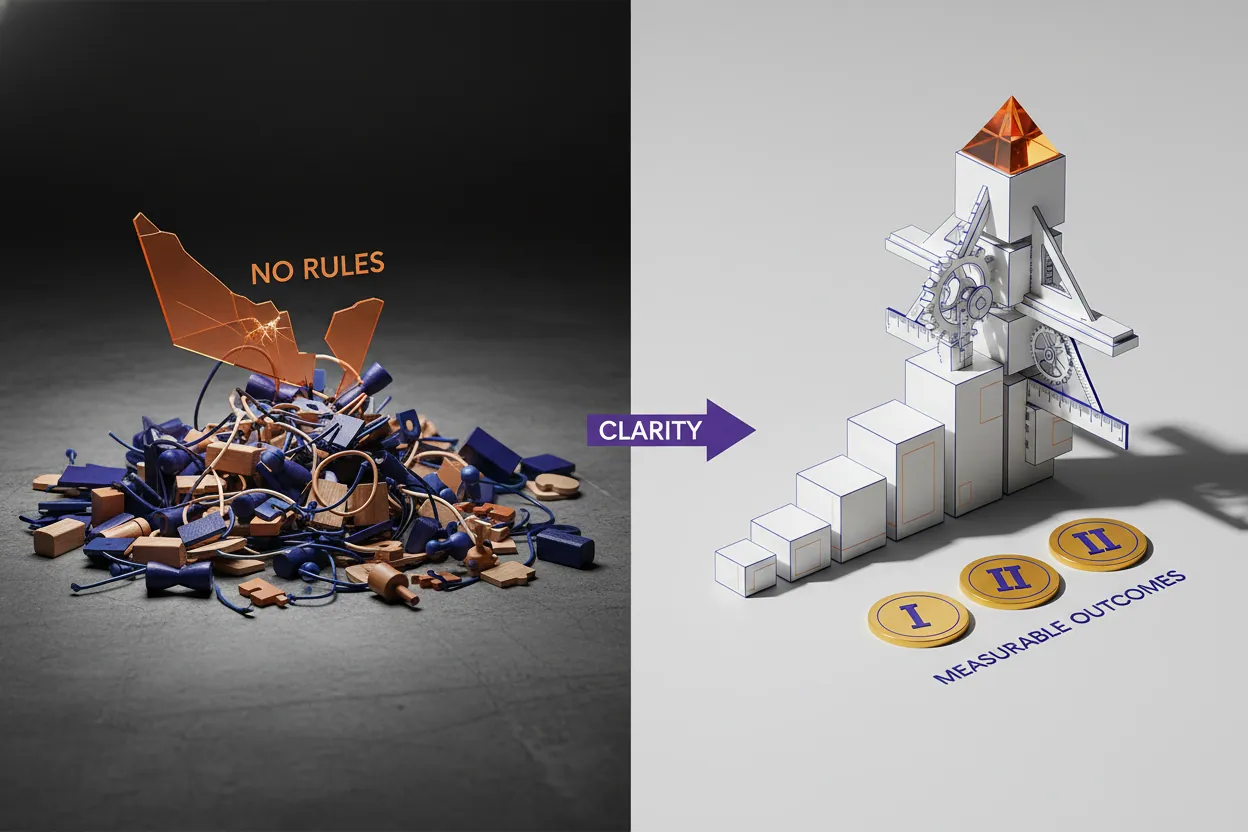
Your team cannot win a game when the rules live only in your head. Clear expectations spell out what good work looks like, which decisions each person can make, and where the limits are, and they are written down where everyone can find them. Start with the decisions that cause the most questions, write the rule and the reason behind it, and test it with the people who use it.
A Game Without Rules Isn't Worth Playing
Every business has rules. The question is whether anyone can see them. When the rules live only in the owner's or manager's head, the team spends its day interpreting, second-guessing and waiting to be corrected.
Do the math on a small team. If ten people each make three decisions a day based on their own reading of an unstated standard, that is thirty chances a day for someone to guess differently than you would have. Over a month, the cost is not only rework. It is confidence. People stop deciding and start asking.
Unwritten rules still get learned. They are learned from whatever gets tolerated, whatever got someone praised last week, and whatever the last workplace did. That is a rulebook too, just not the one you meant to write.

Why Saying It Once Isn't Enough
A verbal expectation has to survive a busy day, a memory, and every listener's own experience. Each person filters what they hear through their last job, their current priorities and what they have watched coworkers do. What sounds clear to you gets interpreted, adjusted and quietly customized. The result is not defiance. It is divergence.
That is why good people make mistakes that look obvious from the outside. Without a clear standard, they fall back on habit and on what worked before. They are not failing to think. They are thinking sensibly inside a system that never told them the answer. The fix is not better people. It is better structure.
Being needed for every decision can feel like leadership. It isn't. It is a sign the business cannot run without you. When you are unavailable, decisions stall. When you are overloaded, quality slips. When someone who knows how things work leaves, that knowledge leaves with them. Writing it down is how a skill one person has becomes the business's capability.
What Clear Expectations Include
A job description tells people what they are responsible for. It rarely tells them how to do the work, how to behave while they do it, or what they are allowed to decide. Clear expectations cover all of it.
| Part | The question it answers | Example in a service business |
|---|---|---|
| Performance standard | What does good work look like, and how will we know? | The steps for a new client consultation (the SOP) and how you judge whether it worked (the KPI). |
| Standard of behavior | How do we treat clients and each other? | Greet every client by name, and raise a disagreement with a coworker in private, not in front of clients. |
| Decision rights | What can I decide on my own, and when do I ask? | Front desk can rebook a late client on the same day; anything involving a refund goes to the manager. |
| Policy | What are the rules of the game? | Every inquiry gets a reply the same business day, and refunds above a set amount need a manager's sign-off. |
In this article, "the rules" means all four parts; the policy is the part that sets the guardrails.
The parts have to agree with each other. Take a business that believes clients should never have to chase it. The policy sets the rule: every inquiry gets a reply the same business day. The SOP shows how: who checks the inbox and voicemail, at what times, and what a good reply includes. The KPI tells you whether it is working: the share of inquiries answered the same day. Each piece backs up the others, so no one has to choose between following the procedure and hitting the number.
When those pieces are designed together, we call it operational architecture. The article on how SOPs and KPIs work together goes deeper on keeping procedures, measures and policies from contradicting each other.
Written Rules Give Your Team More Freedom
Owners often resist writing things down because it feels bureaucratic. But bureaucracy is process for its own sake. Documentation is clarity for the sake of results.
A rule and a restriction are not the same thing. A restriction only answers "What can't I do?" A good rule answers "How do I win here?" When the boundaries are visible, people can act inside them without asking permission, correct themselves without embarrassment, and decide with confidence. Clients feel the difference too: the experience is the same whoever is working that day, which is what predictability means in practice.

Written expectations also make training easier. A new team member can learn the standard from the page instead of piecing it together from three different coworkers, which is a big part of why new hires stay or leave.
Getting expectations, roles and day-to-day operations to line up is part of our business growth consulting.
How to Write Rules Your Team Can Use
You do not need to document everything at once. Start where the friction is.
Start With the Decisions That Cause the Most Questions
List the choices that generate the most questions, need the most approvals, or come out differently depending on who makes them. Sort them by how often they come up and how much they matter. The frequent, high-impact ones go first.
Write the Rule, the Reason and the Limit
For each decision, say what the standard is, why it exists, who can decide, up to what amount, and when to bring someone else in. The reason matters: someone who understands why a rule exists can handle the situation the rule did not anticipate. The goal is not to remove judgment. It is to give judgment clear boundaries.
Test It for Clarity
A good rule is specific enough to guide action, flexible enough to handle reasonable variations, and clear enough that a new employee can apply it without a long explanation. Ask two or three team members to read it separately and tell you what they would do in the same situation. If their answers differ, the rule is not clear yet.
Start Rough, Then Improve It With Your Team
A good draft in use beats a perfect rule that never gets written. Try it in real situations and refine it based on what happens. Involve the people who do the work: they see the gaps leaders miss, and a rule they helped shape is one they already understand. Give each rule an owner so it stays current.

Your Team Wants to Win
A game without rules is not really a game. It is chaos with a scoreboard. Good rules do more than prevent chaos. They give your team a predictable frame for handling the unpredictable.
Your team wants to meet your expectations and make decisions you would be proud of. When they fall short, it is usually not because they do not care. It is because they do not know the rules of the game you want them to play. Write the rules down, keep them where people can find them, and your team gets a real chance to win.

